
Audience research
Part of Match out of home advertising research methods to the buying decision
Do you need out of home advertising buyer personas or audience segments?
How to build out of home advertising buyer personas in England, when to segment instead, what data to use and what each format can and cannot support.
What to take away
- A buyer persona describes the person who signs off the spend, such as a marketing manager at a Manchester retailer with a fixed quarterly budget. An audience segment describes the people the ad reaches.
- For out of home advertising buyer personas, start with the decision maker's constraints: budget cycle, approval route and how they judge a site.
- Use personas to shape the pitch and the media plan, not to predict footfall. Reach and frequency belong to audience measurement.
- Three persona types cover most English briefsthe local owner-manager, the regional marketing lead and the agency planner buying on behalf of a client.
- Keep each persona to one page and review it when budgets or routes change.
Personas or segments: which one does the job
The buyer is not the audience
An audience segment tells you who sees the poster. A buyer persona tells you who releases the money. Those are different people with different questions. The buyer asks about cost per site, contract length and proof the spend worked. The audience asks nothing; they simply walk past.
Three buyer types and evidence
Local owner-manager
- Signs off
- Quickly
- Cares about
- Shop proximity
- Wants
- Site photo, rate
- Write
- One page
Regional marketing lead
- Signs off
- Head office
- Cares about
- Comparable towns
- Wants
- Named town schedule
- Write
- One page
Agency planner
- Signs off
- For client
- Cares about
- Schedule fit
- Wants
- Availability, data, deadline
- Write
- One page
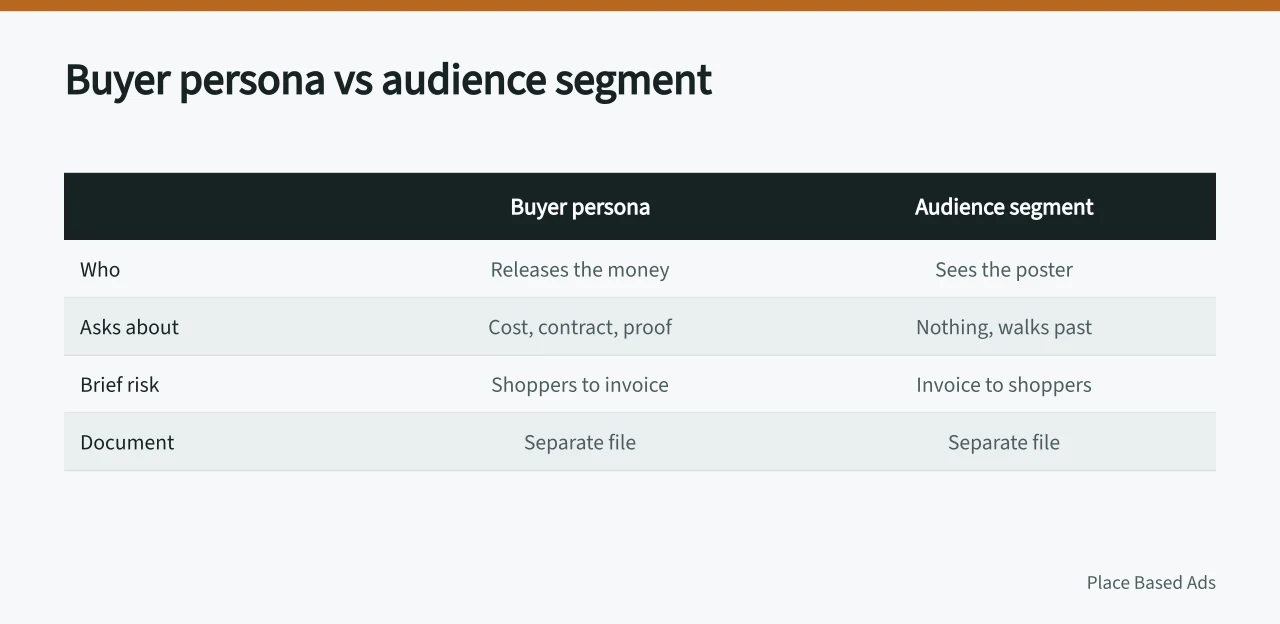
Confusing the two produces briefs that describe shoppers to someone who only cares about the invoice. Keep them in separate documents.
If you are still mapping who is in the market, the out of home advertising audience research guide for England sets out the wider research sequence before you narrow to named buyers.
Three buyer types cover most briefs
A local owner-manager in a town such as Shrewsbury signs off quickly and cares about proximity to the shop. A regional marketing lead at a chain answers to a head office and needs comparable sites across several towns. An agency planner buys for a client and needs format options that fit an existing schedule.
Each type wants different evidence. The owner wants a photo of the site and a simple rate. The regional lead wants a schedule covering named towns. The planner wants availability, audience data and a booking deadline.
Write one page per type. Note the budget cycle, the approval route and the objection you hear most.
What data can support a persona
Use published sources, not guesswork
Persona work drifts into invention when the desk has no data. Anchor each claim to something published. A persona built on a hunch will not survive the first client meeting.
Advertising claims sit under the advertising codes enforced by the ASA and CAP, which matters when a persona document includes comparative claims about formats or rivals. Keep the wording evidential.
Any persona that mentions camera-based measurement needs the ICO guidance on CCTV and video surveillance checked before you promise a client anything about how sightings are counted.
Benchmark digital against out of home honestly
Buyers often compare your rate card with their search spend. Personas should anticipate that question rather than avoid it. Use the Google Ads benchmarking guidance to frame a fair comparison, since the metrics are not like for like.
A persona for a regional lead might note, as a labelled illustrative example, that they currently spend £2,000 a month on paid search and want to test £1,500 on two roadside sites for a quarter.
Numbers like that belong in the persona as context, not as a forecast. Label them clearly.
Building and keeping the persona useful
Where the evidence comes from
Sales call notes are the richest source. Ask every buyer the same four questions: what triggers a campaign, who else approves it, what would stop it, and how success is judged. Record the answers verbatim.
Trade press, rate cards and planning consultations fill the gaps. So does a competitor review, and the out of home advertising competitor research method shows how to compare rival offers without copying their claims.
Review the file every six months. Budgets and routes move.
Glossary
- Buyer persona
- a written profile of the person who approves the spend.
- Audience segment
- a group defined by who sees the advertising.
- Reach
- the number of different people exposed to a campaign.
- Frequency
- the average number of exposures per person.
- Rate card
- the published price list for sites and formats.
Common questions
Does a persona replace audience measurement?
No. Personas shape how you sell and plan; measurement tells you how many people the sites reach. You need both, kept apart.
How many personas should a small sales team hold?
Three is usually enough for an English regional brief: owner-manager, regional marketing lead and agency planner. Add a fourth only when a genuinely different buying route appears.
What makes a persona fail?
Invented detail. If a claim cannot be traced to a call note, a published source or a rate card, cut it or label it as an assumption.