

Reviews
Part of When to trust out of home advertising reviews and when to verify instead
An out of home advertising review methodology without the vendor spin
How we score out of home advertising suppliers: what gets assessed, what does not, and how vendor claims are separated from independent evidence.
What to take away
- A Manchester media team defending a six-figure roadside buy should be able to show which supplier claims were checked and which were taken on trust. This method produces that file.
- We assess supplier documentation, published audience data, code compliance and pricing structure. We do not test sites in person or audit internal systems.
- Vendor claims are labelled as claims. Independent evidence, such as ICO enforcement, is labelled as evidence. Editorial judgement is labelled as judgement.
- Every score carries a weight, so a weak data protection position cannot hide behind a strong sales deck.
- No hands-on testing is claimed, and no supplier pays for a placement.
What the review assesses
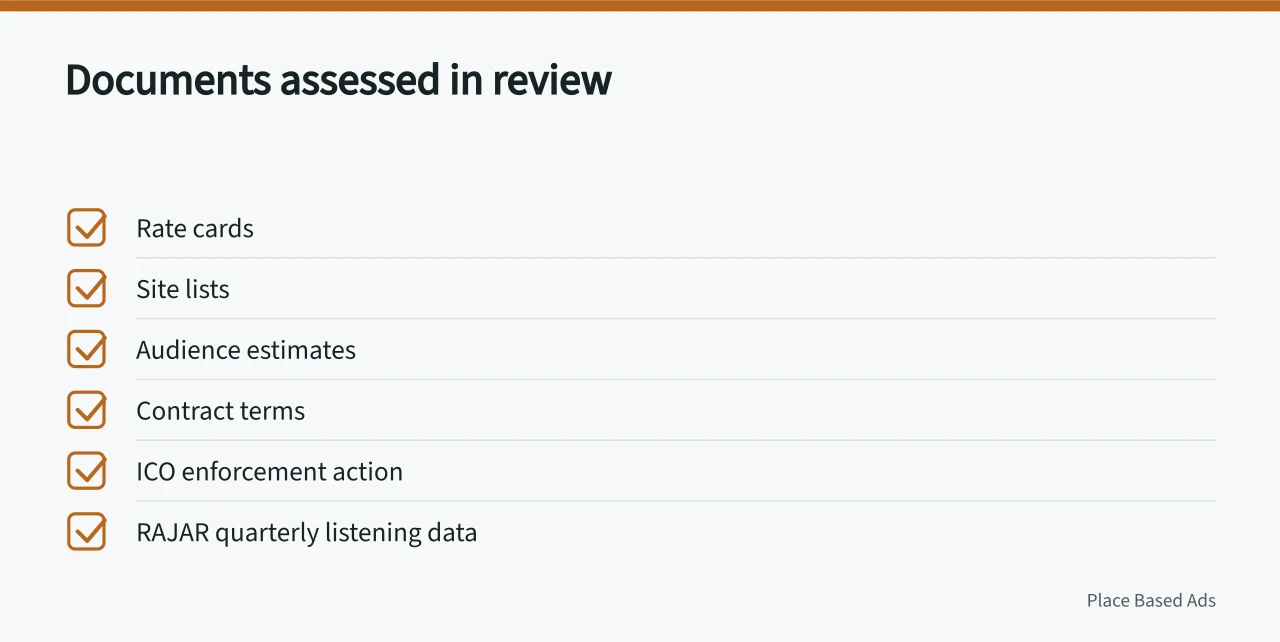
Start with the documents a supplier hands over: rate cards, site lists, audience estimates and contract terms. Each is read against the CAP Code, which governs non-broadcast advertising in the UK and so covers out of home claims.
Requests go out in writing before scoring starts. An undated audience estimate scores lower than a figure a third party published, because a buyer cannot check a number with no source attached.
Audience figures are then traced to source. A supplier citing audio-adjacent reach is checked against RAJAR quarterly listening data rather than accepted at face value.
Data handling is assessed separately. Where targeting or measurement touches personal data, published ICO enforcement action is reviewed as a signal of regulatory risk.
Not assessed: site condition, illumination, footfall on the day, or the accuracy of a supplier's booking system. Those need site visits and system access we do not have.
Separating vendor claims from evidence
Each statement in a supplier pack is tagged. A claim is anything the supplier asserts about its own performance or exclusivity. Evidence is anything a third party published, such as a regulator's ruling.
Claims vs evidence tagging
Vendor claim
- Source
- Supplier assertion
- Score band
- Lower band
- Buyer action
- Request written assurance
Third-party evidence
- Source
- Regulator ruling
- Score band
- Higher band
- Buyer action
- File as verified
An unsupported claim is recorded as unverified and scored at the lower band. A buyer signing off in Leeds or Birmingham needs a defensible file, not a persuasive one.
Where a supplier's audience number cannot be traced to a dated source, the file records the gap. A buyer can then ask for it as a written assurance in the contract.
The same discipline sits behind the comparison methods used for out of home advertising, where evidence tiers are set before any supplier is scored.
The scoring rubric
| Criterion | Weight | What earns a high score |
|---|---|---|
| Audience evidence | 25% | Figures traceable to a named, dated third-party source |
| Code compliance | 20% | Copy consistent with the CAP Code, no upheld complaints found |
| Data protection | 20% | Clear lawful basis for personal data use, no adverse ICO action |
| Pricing transparency | 15% | Full rate card, production and installation costs in writing |
| Contract terms | 10% | Cancellation, make-good and renewal terms stated clearly |
| Reference quality | 10% | Named clients who will speak, not logos alone |
Weighted scores are banded. A supplier strong on pricing but weak on data protection cannot reach the top band, however attractive the rate card looks.
Each criterion is scored from one to five against written evidence, and the weights are fixed before any supplier pack is opened.
What the rubric does not measure
Creative quality, site aesthetics and personal rapport sit outside the score. They are legitimate factors, but they are not evidence.
How to use the bands
A top band means the file supports sign-off. A middle band means gaps should be closed before commitment. A low band means written answers are needed first.
A supplier can move bands as gaps are closed, so every file carries the date of assessment.
Where editorial judgement enters
Some criteria cannot be scored mechanically. Whether a supplier's account of a measurement gap is credible is a judgement call, recorded as such.
Judgement also settles how much weight a single upheld complaint carries. One ruling in a narrow product category counts for less than a pattern across several campaigns.
Judgement is shown next to the evidence that informed it, so a reader can disagree with the conclusion and still see the facts. The same principle applies when reviewing out of home advertising agencies in England, where local market conditions change what counts as a reasonable answer.
Common questions
Does a supplier pay to be reviewed?
No. Placement is not sold, and no supplier has editorial input into a score. Any commercial relationship would be disclosed at the top of the review.
What if a supplier refuses to provide documents?
Missing items score at the lowest band and are recorded as unavailable. A refusal is itself a finding.
How often are scores revisited?
Scores are a snapshot tied to the date of assessment. A supplier that changes its rate card, contract or data practices would need a fresh review.
Can a low score be appealed?
A supplier can submit further evidence, assessed against the same rubric. The original score stands unless the new evidence changes the underlying facts.